The Mafia's Dirty Secret: It’s Not a Gang. It’s a Corporation.
Let me ask you something…
What comes to mind when you hear the word “Mafia”?
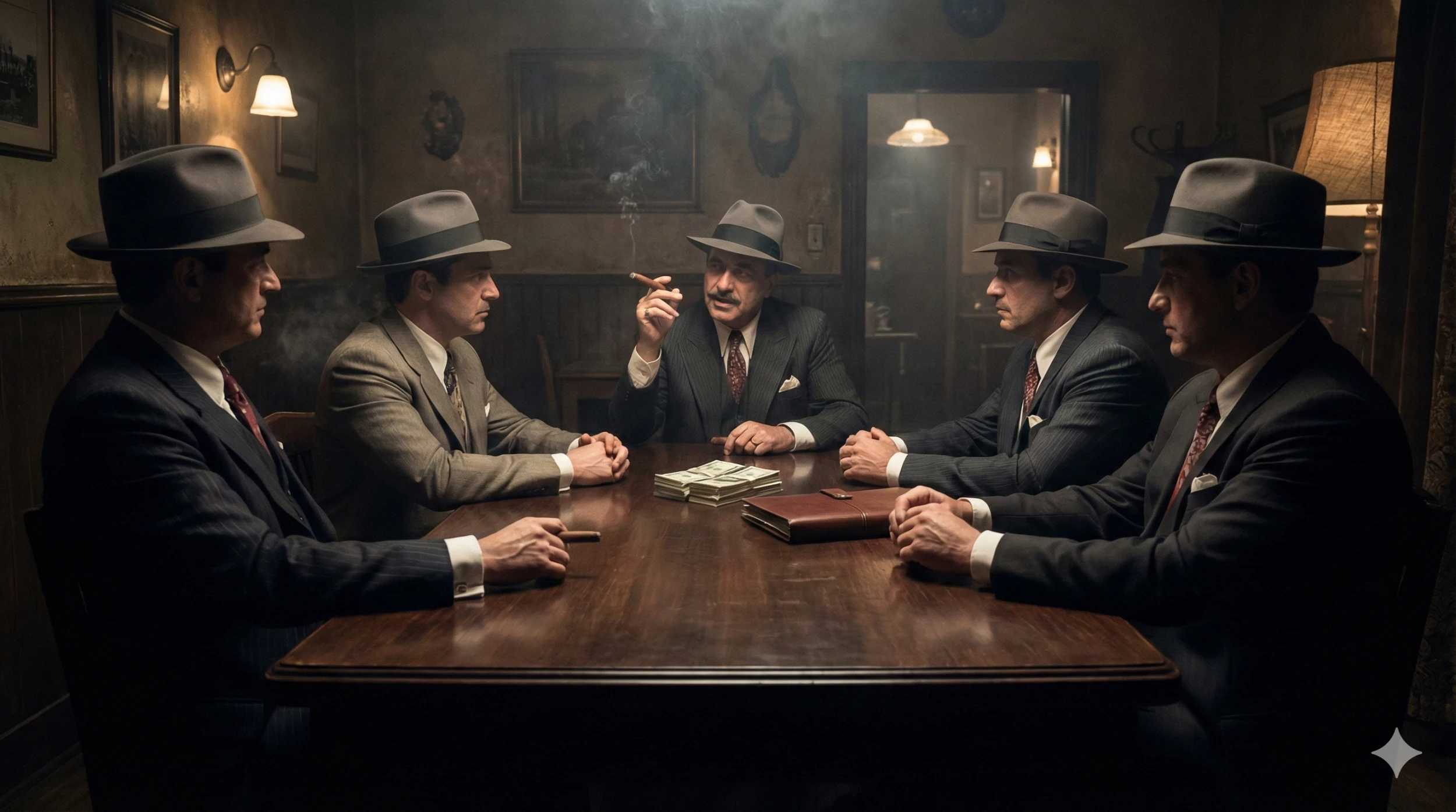
Dark alleys. Tommy guns. Ruthless thugs.
That’s the *story* we’ve been sold.
But what if I told you that story is dead wrong?
What if I told you the most powerful criminal organizations on the planet operate with more discipline, more efficiency, and more contractual integrity than most Fortune 500 companies?
Sounds crazy, right?
But here’s the thing…
I dug into the real research. I looked past the Hollywood myths. And what I found will flip everything you think you know about organized crime upside down.
The Anomaly That Changes Everything
Here’s the first clue.
In the official Wikipedia entry, buried in the academic jargon, is this bombshell line:

> “The central activity of such an organization would be the arbitration of disputes between criminals, as well as the organization and enforcement of illicit agreements between criminals through violence.”
Stop.
Read that again.
Arbitration of disputes. Enforcement of agreements.
Does that sound like a random gang of thugs to you?
Or does it sound like a private court system? A contract enforcement agency for a world where the government can’t—or won’t—operate?

This isn’t about mindless violence.
This is about filling a market void.
The Protection Racket That Isn't a "Racket"
Let’s get specific.
Scholar Diego Gambetta didn’t study the Mafia as a cop. He studied it as an economist.
And his conclusion was staggering.
He characterized the Sicilian Mafia as a “cartel of private protection firms.”
Their primary product? Trust.
Think about a simple black-market deal. A grocer wants to buy untaxed meat from a butcher.
The grocer is afraid he’ll get rotten meat. The butcher is afraid he won’t get paid. There’s no legal contract. No police to call.

So the deal dies.
Enter the Mafioso.
For a fee, he acts as the trusted third party. He guarantees the deal. If the butcher cheats, the mafioso punishes the butcher. If the grocer cheats, he punishes the grocer.
Suddenly, a profitable transaction that was impossible… becomes possible.
The mafioso isn’t *just* an extortionist. He’s a facilitator. He’s providing a service the state has failed to provide.
This is the core anomaly.

The Mafia isn’t *disrupting* commerce in its territory. In many cases, it’s enabling it—for a price.
The "Krysha" Principle: Why This Isn't Just Italian
Now, you might think this is a Sicilian oddity.
Wrong.

Look at Russia after the Soviet collapse. The state and police were in chaos. Contracts were worthless. Property was unprotected.
What emerged?
Gangs called “Krysha.” The Russian word for “roof.”

These groups weren’t *just* stealing. They were selling protection and contract enforcement to desperate businesses. They became the de facto legal system for the underworld—and much of the regular economy.
In Japan, it’s the Yakuza. In China, it’s triads.
The pattern is global.

Wherever there is a vacuum of official trust—where the government is weak, corrupt, or absent—a mafia-type organization emerges to sell that trust.
It’s a universal business model.
The Ultimate Legal Admission
This brings me to the most compelling proof.
In 1982, Italy created a specific law: Article 416-bis.
It doesn’t just outlaw “gangs.” It defines a “Mafia-type association.”
And the definition is precise. It’s an association that uses intimidation and *omertà* (silence) to… > “directly or indirectly assume management or control of financial activities, concessions, permissions, enterprises and public services for the purpose of deriving profit.”
Let that sink in.
The Italian government itself, in law, defines the Mafia not by murders, but by its corporate-like takeover of economic sectors.
This isn’t a gang. It’s a shadow conglomerate.
The Brutal Truth About "Efficiency"

Now, don’t get me wrong.
I’m not romanticizing this. Their “contract enforcement” tool is horrific violence. Their “arbitration” ends in corpses.
But you have to ask…

Why do they outlast governments?
Why has the ‘Ndrangheta, for example, endured for centuries, outliving empires, while startups fail in 18 months?
Because they solve a fundamental human problem: the need for predictable rules in transactions.

They provide a brutal, terrible, but *clear* system where the official system has broken down.
They are hyper-efficient within their own amoral framework.
The Realization That Changes Your Perspective
So, what’s the takeaway from all this?
The Mafia’s power doesn’t come from being the most savage.
It comes from being the most reliable provider of a critical service in a lawless environment.
They aren’t rebels against the system.
They are a parallel system.
They aren't chaos.
They are a dark, mirror-image version of order.
Final Thought
The next time you hear about a “mafia,” don’t just think of criminals.
Think of a brutally efficient, vertically integrated service corporation that has mastered the art of selling the one thing every human in business ultimately needs:
Certainty.
And ask yourself…
In a world where trust in institutions is fading… what other “mafias” are we not seeing yet?